After the success of ‘Teal’ independent candidates in the 2022 federal election there was thought to be room for independents in the subsequent state election in Victoria. Being within the now independent federal electorate of Goldstein a small but driven group of the community sought to present the idea of an independent candidate for the state electorate of Brighton. I joined this group months out from the election as the sole design professional, and began what would be the most challenging chapter in my career so far.
The entire process was a collaborative effort, with group Zoom calls or in-person meetings at our campaign office every couple of days, alongside phone calls, emails, and Slack messages. Most of my direction came from either round-table discussions amongst the ‘exec’ team, or directly from the candidate, campaign manager, or operational manager, depending on what we were planning, or what needed to be done. While some other Independent campaigns had the backing of funding groups, ours did not, and as such available capital needed to be carefully managed.
The goal for the campaign was twofold; firstly, to get our candidate elected, and secondly, to put pressure on the major parties to take notice of a freshly marginal electorate. This was to be accomplished through three prongs, direct community interaction, leveraging the candidates professional connections, and creation of print and digital collateral. The latter of which being my focus.
The result of our work was 9.11% of first preference votes (out of 48000 voters), the second highest signage visibility in the electorate (behind the incumbent party), enough pressure to magnetise tens of millions of dollars in election promises and pledges from the major parties (whether anything materialises from this is another question), and the perceived clout to have even the ABC following our vote count vs the incumbent party, rather than both the majors on election night.
Below are final versions, prints, and posts of all work I created for the campaign with a few comments and anecdotes.
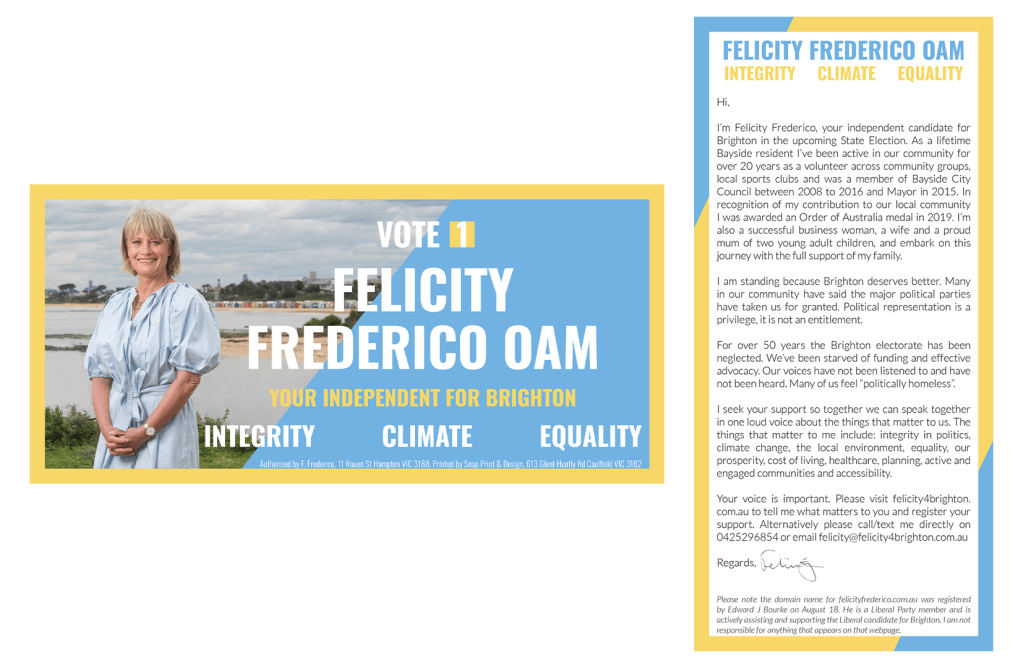
Our first ‘drop letter’ featured an introduction to the candidate, delivered by volunteers to some 28000 households in the Brighton electorate.
Every single piece of printed collateral needed ‘Authorisation’ included. This wasn’t generally an issue, however, it was incredibly important to be mindful of where it would go on any given item, and how legible it would be.
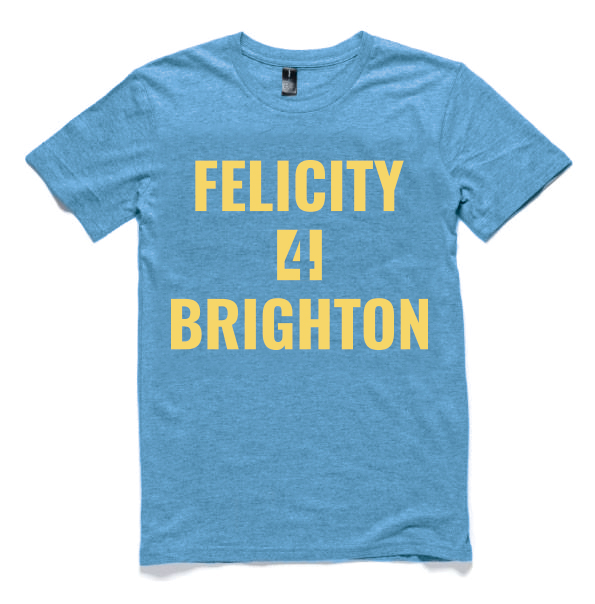
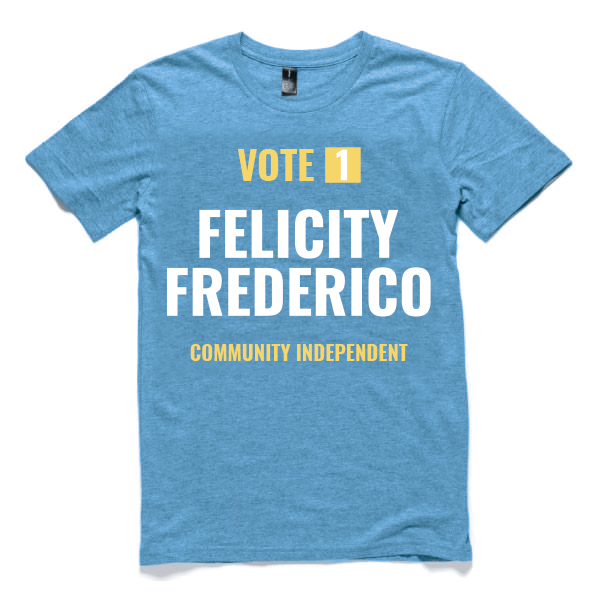
Shirt 1 (Left), created the first week I joined the team and Shirt 2 (Right), created a week before pre-polling began.
The need for change prior to our second print run came from our branding having evolved since the start of the campaign, and the unfavourable messaging behind the number 4 in a box for election with preferential voting.
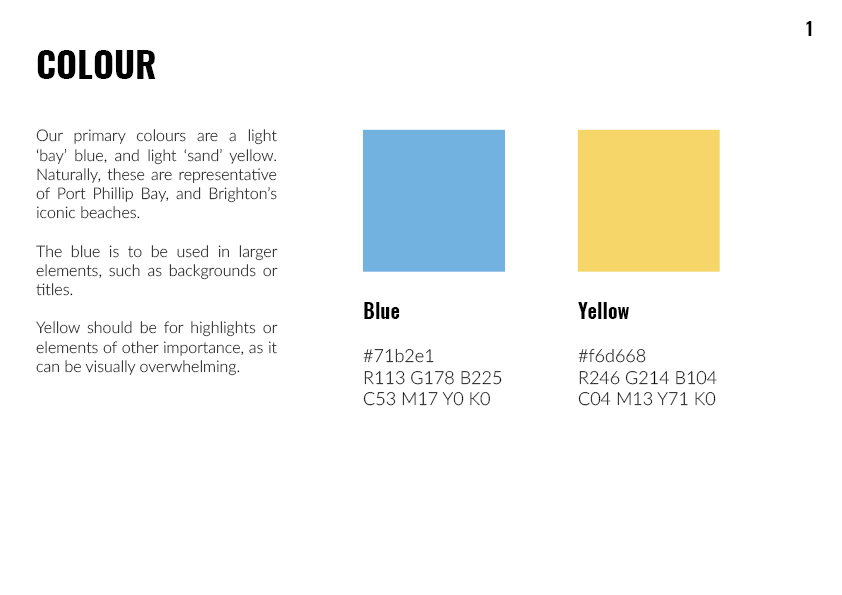
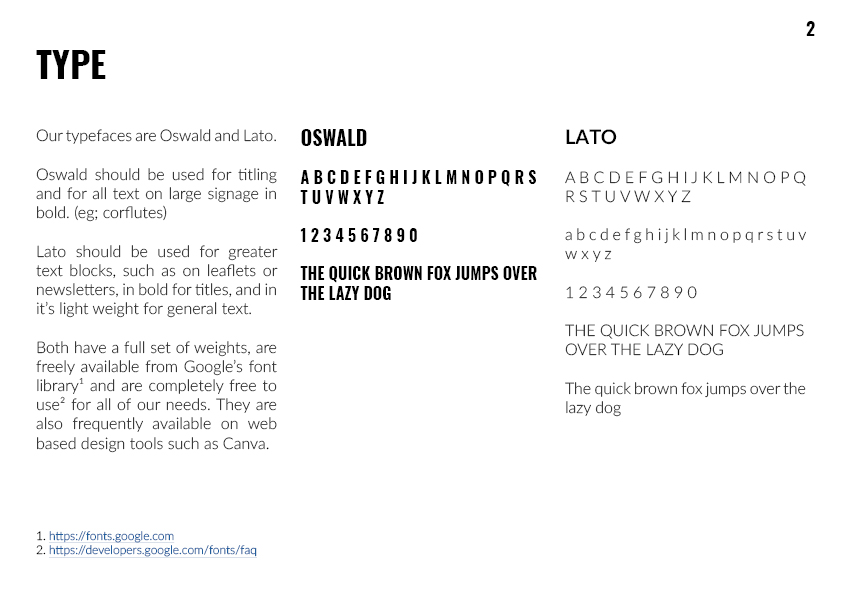
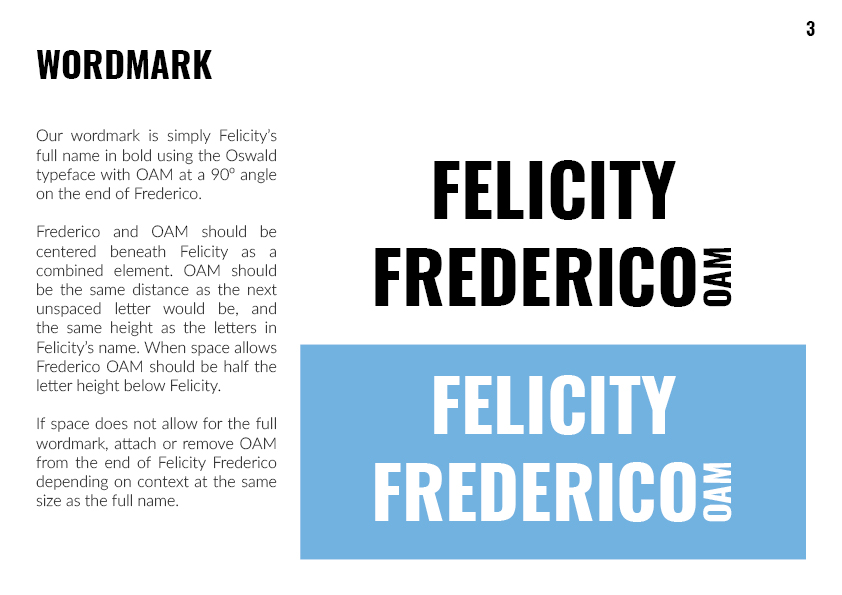
After realising the breadth of the work I’d have to undertake over the coming months I created a simple brand guideline PDF for when other volunteers needed to supplement the work I was doing, either through creation of social tiles or flyers. It defined the colours, typefaces, and wordmark we would be using going forward.
Our style evolved quickly over the first few weeks and I often found myself having to tweak the guidelines in tandem. Our colours were a particular topic of discussion at our initial meetings.

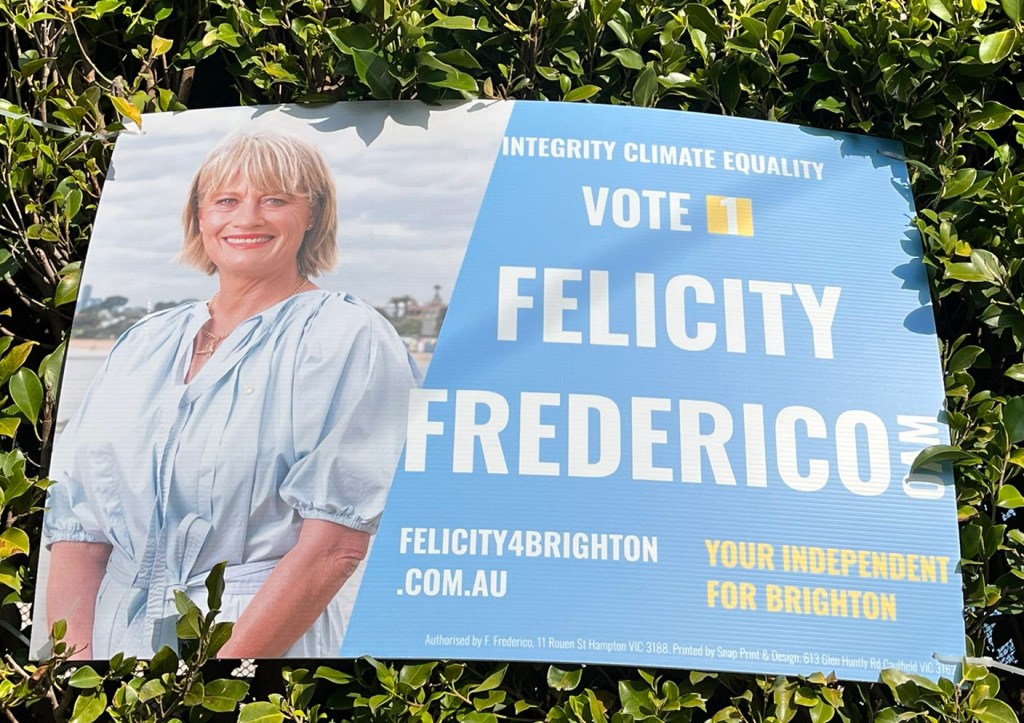
Corflutes are a weird and wonderful form of signage so called for the material they’re printed on.
Taking into account having no say in where or how they’ll be displayed, and how much sun they might catch, made designing for it an interesting challenge. Prototyping on glossy photo paper helped considerably.
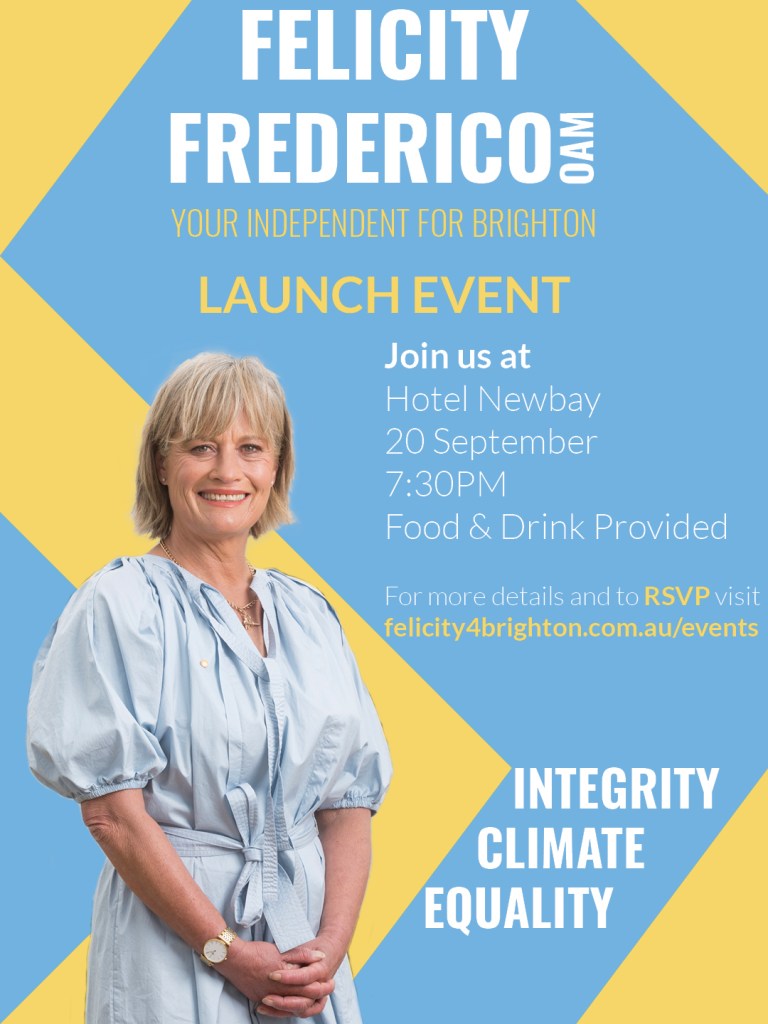
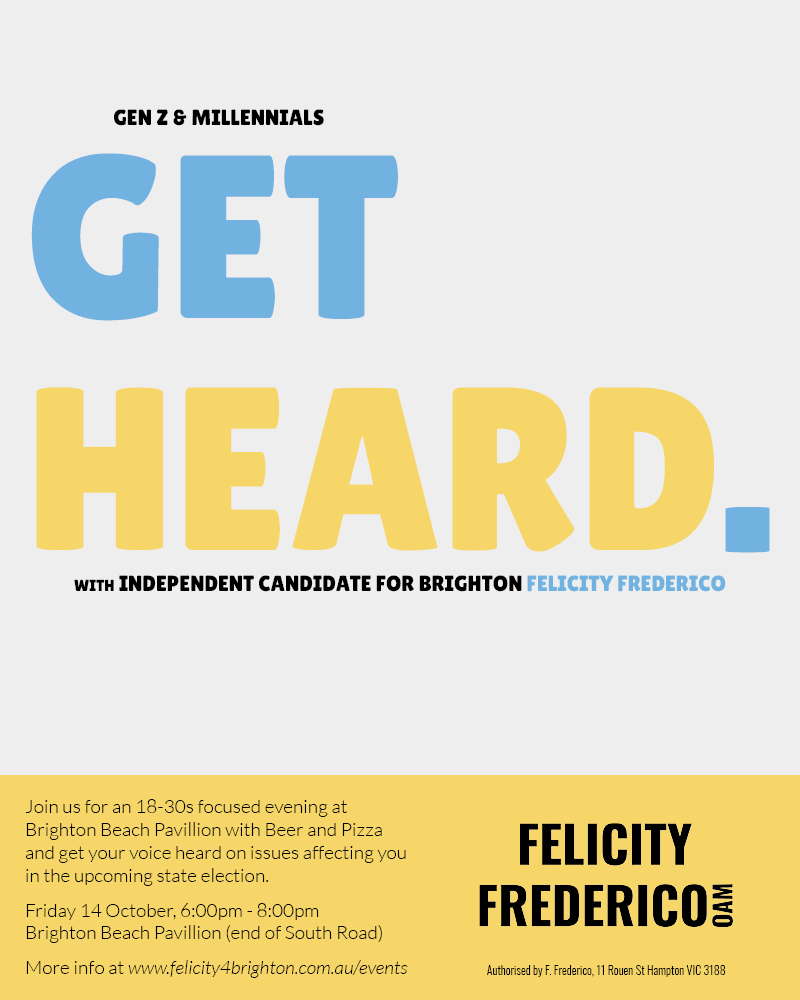
A number of campaign events required flyers to be put up at the venues. These were somewhat tailored to the audience attending. As the event frequency increased we also had a pair of tear-drop banners printed to stand beside the candidate when there was space.
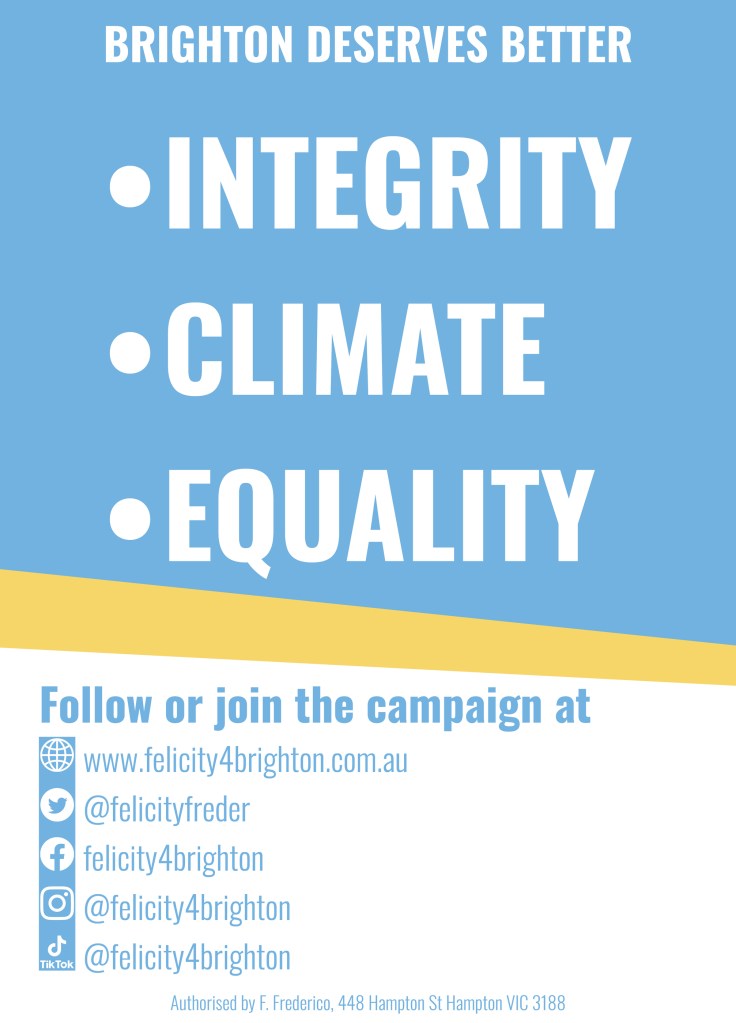
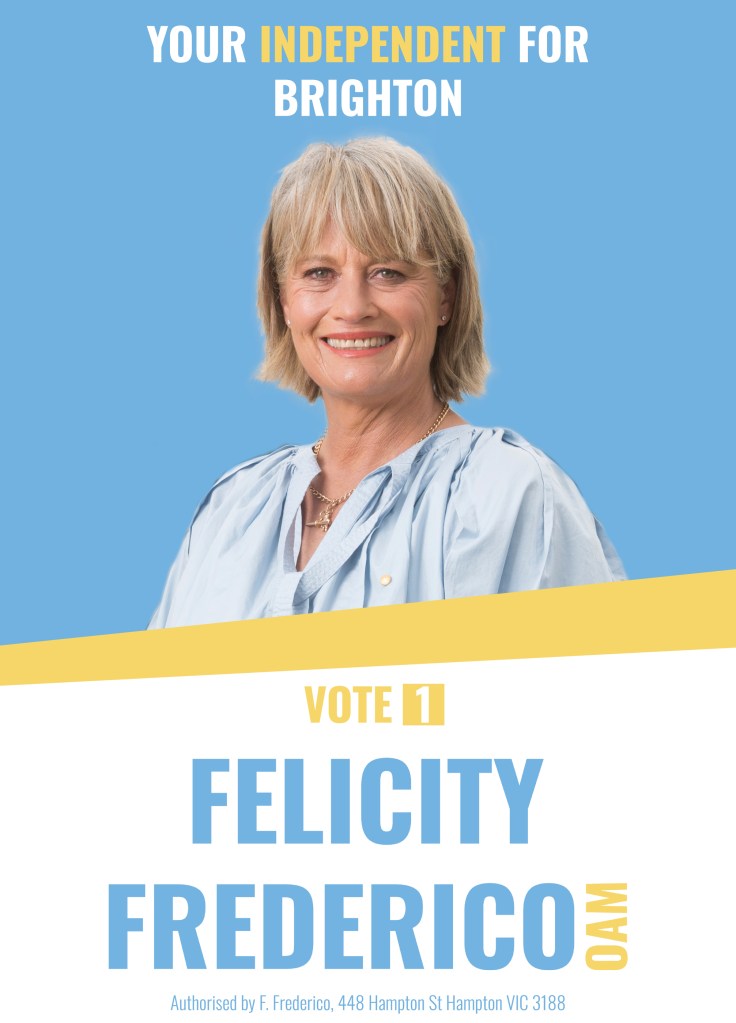
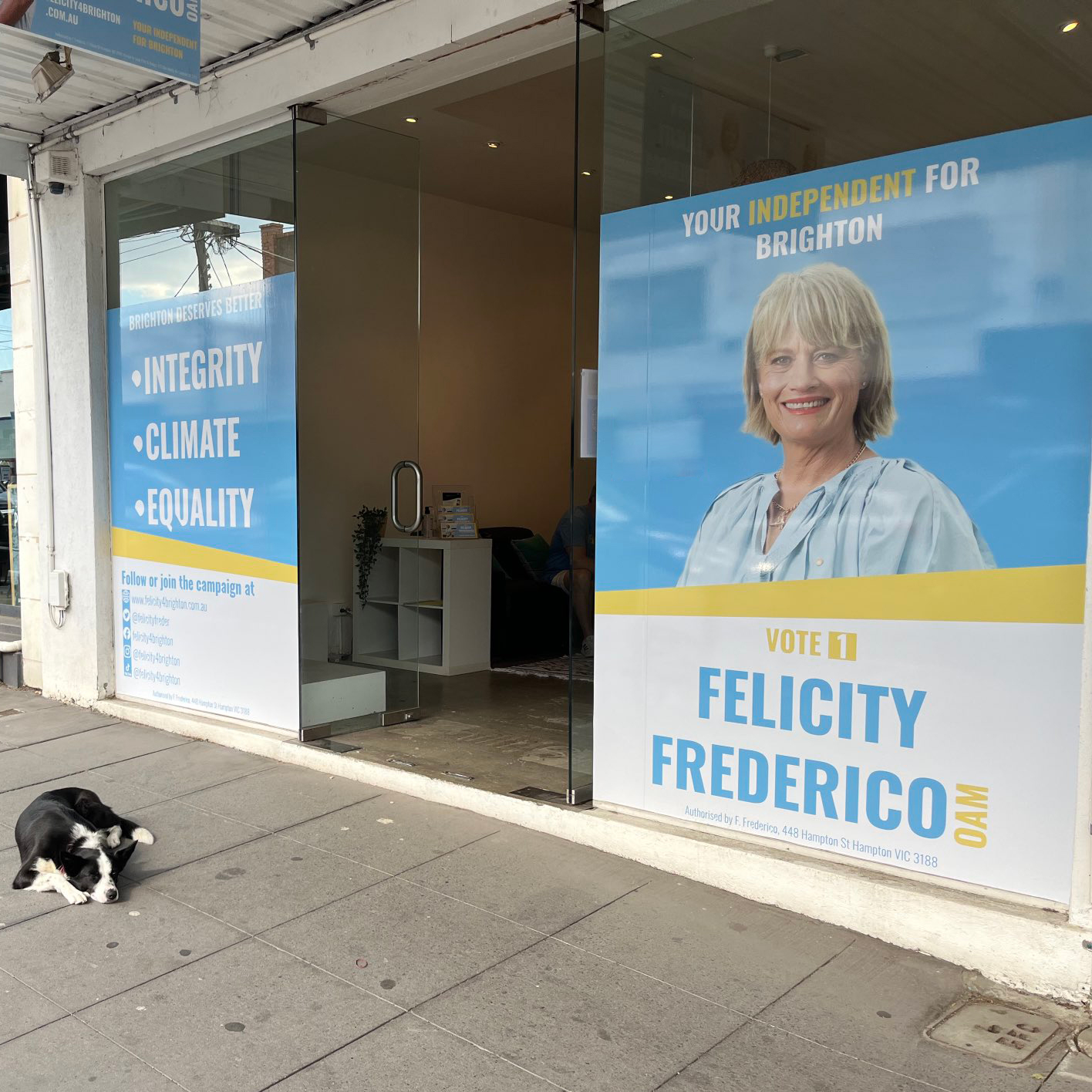
Not far out from pre-polling the team acquired a temporary shop front to work out of in the lead up to election day. To make it a bit more official I was requested to prepare a window wrap.
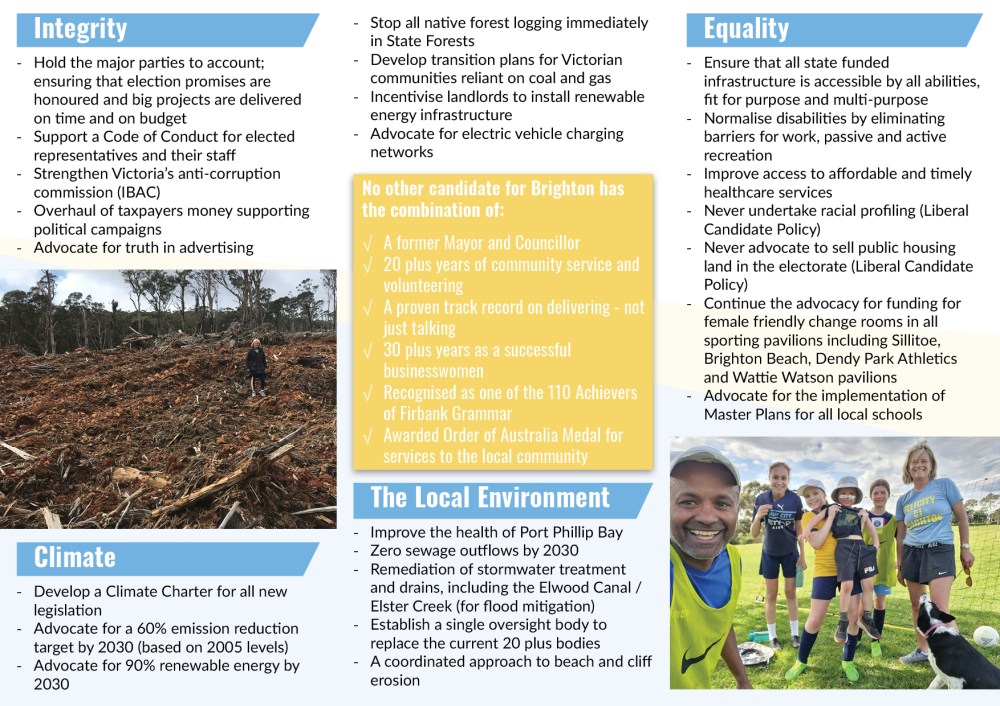
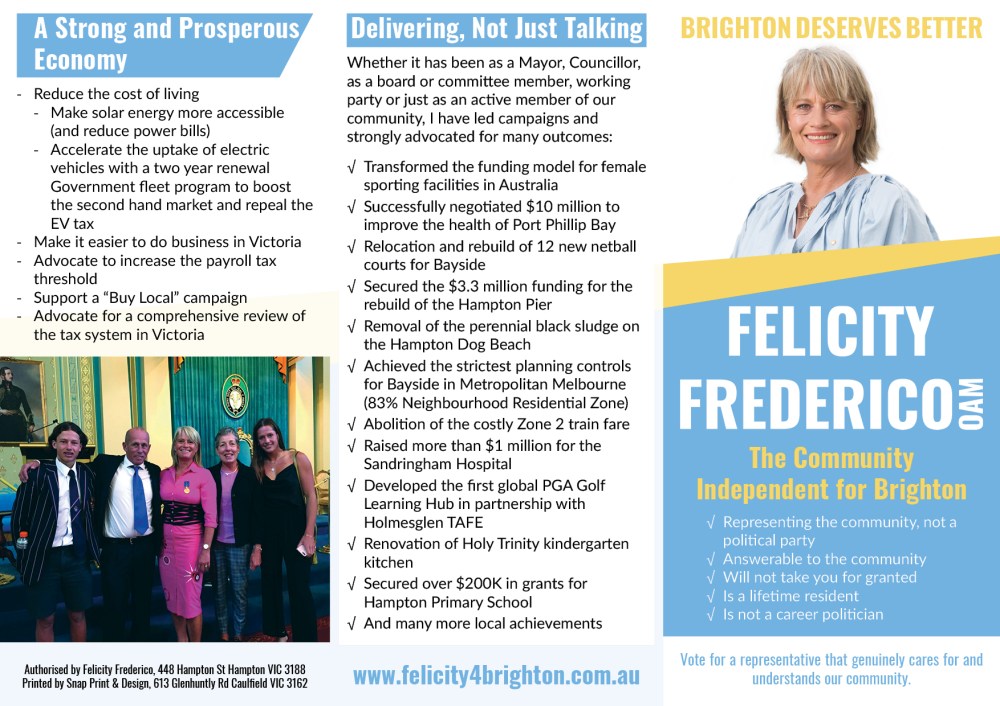
Our second drop letter was a c-fold brochure, with more emphasis on policy and standpoints.
The team elected to use Australia Post to deliver the drop letter this time around due to the proximity to election day and the need for volunteers to be ready and rested at polling places.
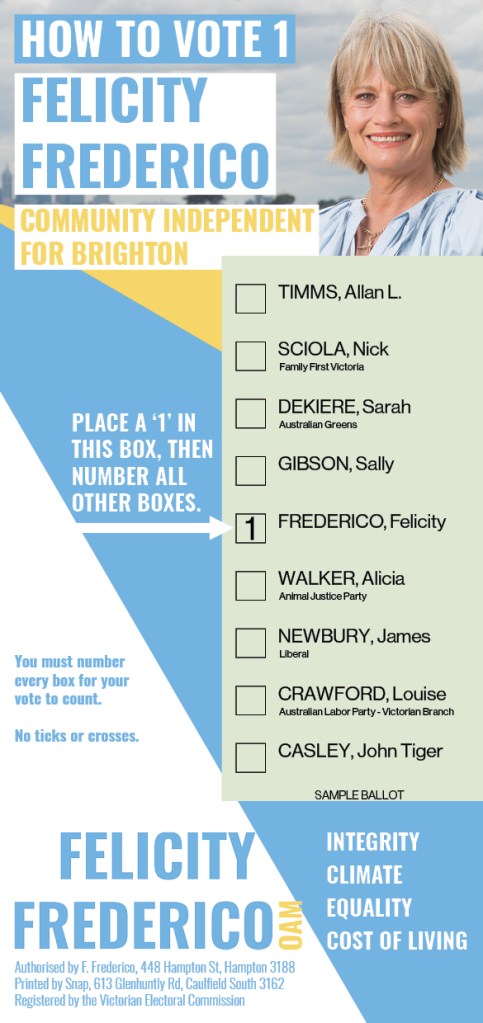

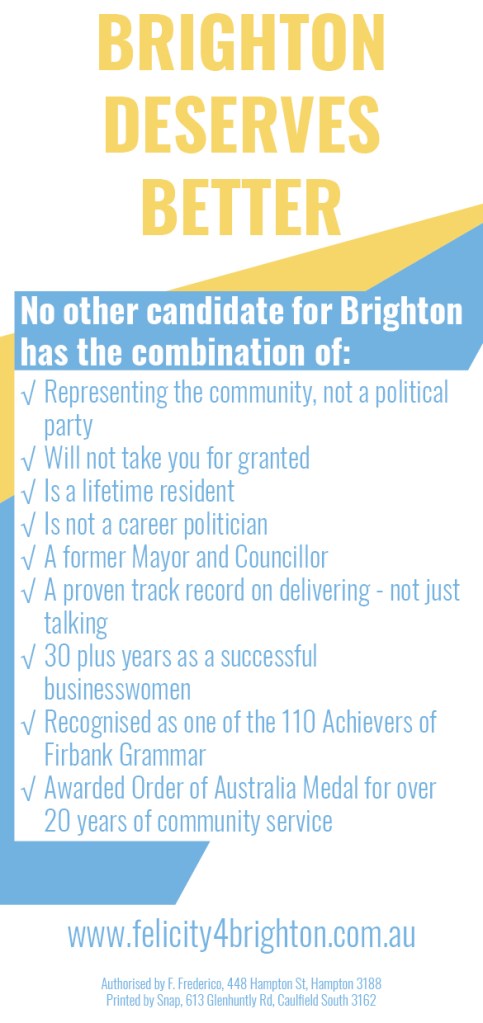
The creation of How to Vote (HTV) cards, for anyone unfamiliar, is an exercise in agility; both in terms of the need for quick changes to the design to meet the evolving nature of the electoral endgame, and running up the street to the electoral office over half a dozen times during the singular week submissions are open.
The left most image is the front of our first submission, and the middle our second. The right most image is the rear of our first submissions, and was accepted by the Victorian Electoral Commission (VEC) in all cases.
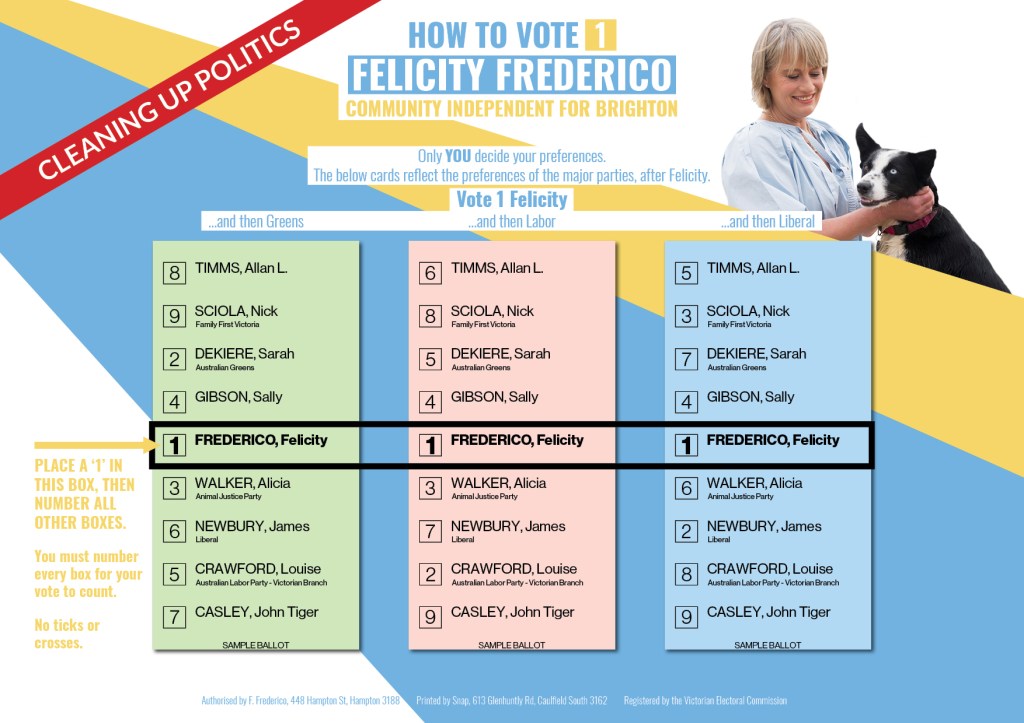
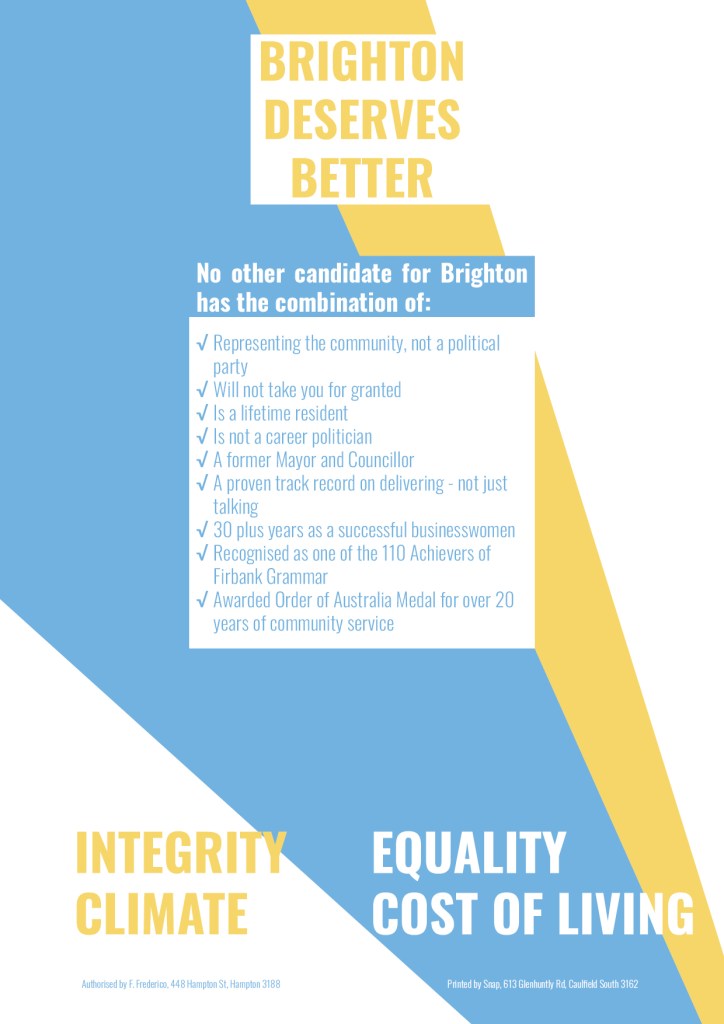
The third How to Vote card we submitted was an A4 sheet displaying the voting preferences of the Greens, Labor, and Liberal parties (left to right), albeit with Felicity replacing the first preference for each. This was due to a contest over the VEC’s guidelines which seemed to be interpreted differently depending on who you spoke to (more on that here). In the end our initial designs would’ve been allowed after better funded independent campaigns took the VEC to court and had the guidelines relaxed… after we’d received our print run of the above A4 HTVs.


As I have experience with video editing and knowledge of the workings of YouTube and TikTok I was tasked with recording some of the candidate’s speeches and Q&As at a handful of campaign events, or using videos the others would record, and turning them into short form content. After some research and time spent prototyping I ended up with a style incorporating large subtitles in campaign colours and cut down versions of speeches with the most important messaging. I later began to add light camera effects to maintain viewer attention (where raw footage allowed).
Given that even the majors have difficulty getting traction on these platforms we decided our goal was less about overall performance, and instead the team agreed that being able to direct voters somewhere to get concise answers to some of their questions about policy would be worth the time investment.
In total we had 1343 views on TikTok, 4986 views and 22.7 watch hours on YouTube across seventeen videos.
 Alex Nutman